

Emergency in the Skies:
The Diversion of Delta Flight DL275
Home »Emergency in the Skies: The Diversion of Delta Flight DL275
- Haris ALi l November 10, 2025
Introduction:
The atmosphere inside Detroit Metropolitan Wayne County Airport (DTW) is always charged with a specific kind of kinetic energy. It is a hub of motion, a crossroads of the world. But for the passengers waiting at the gate for Delta Flight DL275, the energy is different; it is the anticipation of the long haul. They are not just flying to a neighboring state; they are preparing to cross the date line, to chase the setting sun all the way to Tokyo Haneda (HND).
The aircraft sitting at the gate is a marvel of modern engineering: the Airbus A350-900. Its wings curl gracefully at the tips, its engines are massive turbines capable of generating tens of thousands of pounds of thrust, and its livery proudly bears the Delta widget logo on its tail. For the 300+ souls on board—business travelers adjusting their watches, tourists clutching guidebooks, and families returning home—this machine is their capsule of safety for the next 13 hours.
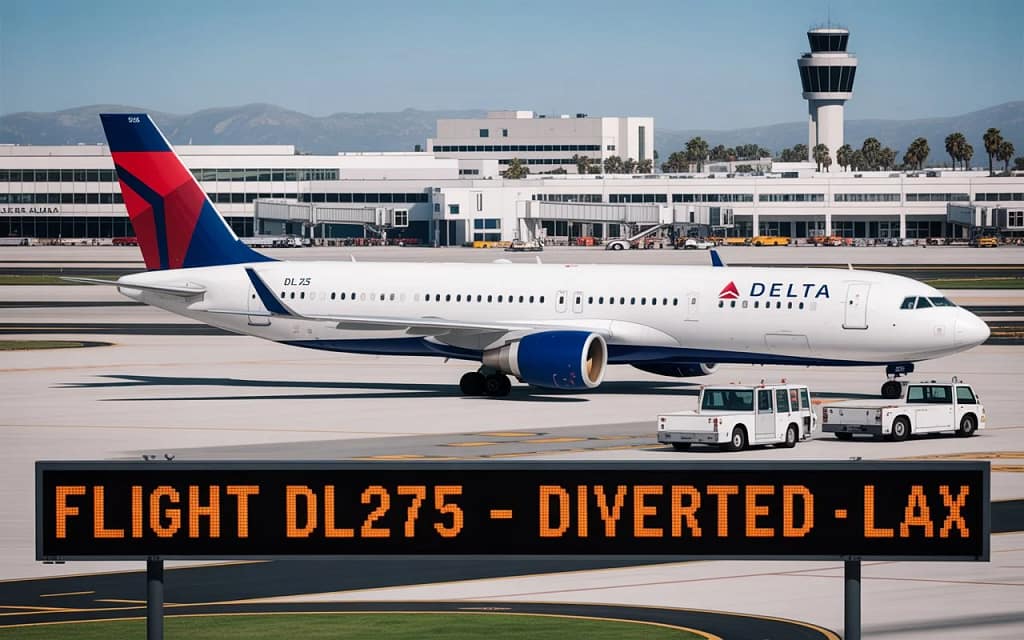
However, aviation is a dynamic environment. Despite the trillions of data points analyzed by Delta operations centers, the precision of the pilots, and the robustness of the aircraft, the unexpected can happen. Flight DL275 is about to become a case study in safety, decision-making, and the complex logistics of a transpacific diversion. This is the story of how a direct flight to Japan found itself descending over the palm trees of Los Angeles.
The Titan of the Skies
To understand the gravity of a diversion, one must first understand the flight itself. Delta Flight DL275 is a flagship route. It connects the heart of the American automotive industry with the bustling metropolis of Tokyo.
The route is technically demanding. It typically follows a “Great Circle” path. This means the plane flies North, often crossing over Canadian airspace, skimming the edge of the Arctic Circle, passing Alaska, and then arcing down the Russian coast or the Northern Pacific Ocean toward Japan. It is a lonely route. For hours, there is nothing below but freezing dark water or endless tundra.
This isolation is why Delta utilizes the A350 for this mission. The aircraft is ETOPS-certified (Extended-range Twin-engine Operational Performance Standards). In layman’s terms, this certification means the plane is so reliable that it is allowed to fly long distances away from the nearest airport. But “reliable” does not mean “invincible.” Even the most advanced Delta aircraft relies on thousands of interconnected systems—hydraulics, avionics, pressurization, and anti-ice mechanisms. If just one of these systems shows a fault reading, the entire mission profile changes.
The Departure and the Shift
The flight begins routinely. The heavy jet lifts off from Detroit, banking smoothly into the sky. The seatbelt signs flick off. The cabin crew, dressed in the distinct purple and charcoal uniforms of Delta, begin their service. The smell of warm meals fills the cabin. Movies start on seatback screens. Passengers settle into the rhythm of the long haul.
Three hours pass. Then four. The aircraft is cruising at 38,000 feet.
But in the cockpit, the atmosphere shifts. The pilots, highly trained professionals with thousands of flight hours, receive a notification. It might be a subtle amber light on the ECAM (Electronic Centralized Aircraft Monitor) or a message from Delta maintenance control via satellite link.
In the case of many diversions on this specific route, the culprit is often the Anti-Ice System. Flying over the Northern Pacific requires the engines and wings to be heated to prevent ice buildup. Ice is the enemy of flight; it changes the shape of the wing and disrupts airflow. If the system indicates a failure—even if the engine itself is running perfectly—the rulebook is clear. You cannot enter icing conditions without protection.
Alternatively, the interruption could be human. A passenger in row 42 clutches their chest. A medical emergency at 38,000 feet is a crisis of time. The Delta flight attendants are trained in first aid and have access to medical kits, but they are not surgeons.
Whether mechanical or medical, the decision rests with the Captain. The “Go/No-Go” moment arrives. Tokyo is too far. Returning to Detroit is counterproductive. The flight management computer is queried for the best alternate airport.
The answer comes back: LAX. Los Angeles.
The Turn South
For the passengers, the first sign that something is wrong is usually the flight map. A sharp-eyed traveler watching the “Airshow” moving map will notice the plane banking left—hard. Instead of pointing West toward Alaska, the nose of the Delta jet turns South.
Then comes the chime of the PA system. The Captain’s voice is calm. It is a practiced tone designed to convey authority and suppress panic.
“Ladies and gentlemen, this is the Captain speaking. We have identified a minor technical indication in the cockpit. Out of an abundance of caution. Delta safety protocols, we have decided to divert to Los Angeles. The aircraft is flying normally, and we are in no immediate danger.”
“Diversion.” The word ripples through the cabin. The psychology of the cabin changes instantly. The movie screens lose their appeal. Passengers look at one another. Why Los Angeles? That’s not on the way to Tokyo.
In reality, the choice of Los Angeles is strategic for Delta.
Weather: The Northern Pacific route can be turbulent and icy. Flying south to California ensures better weather, reducing the strain on the aircraft.
Maintenance: LAX is a major hub. Delta has extensive maintenance crews, spare parts, and ground support there. If the plane needs a fix, LAX is the place to do it.
Runway Length: A fully loaded A350, heavy with fuel meant for Tokyo, is incredibly heavy. It needs a long runway to land safely. LAX provides this.
The Mechanics of the Descent
As DL275 heads toward California, the pilots are busy. They are communicating with Air Traffic Control, requesting a new flight path. They are also coordinating with Delta’s Operations Control Center (OCC) in Atlanta. The OCC is the “nerve center” of the airline, where dispatchers are already working on a plan B for the passengers before the plane even touches the ground.
One critical issue is weight. The plane took off with enough fuel to fly for 13 hours. It has only flown for perhaps 4 or 5. It is too heavy to land safely without stressing the landing gear.
The pilot may have to perform a fuel dump or simply fly a longer route to burn off the kerosene. If passengers look out the window, they might see a stream of white mist trailing from the wings—fuel being jettisoned into the atmosphere to lighten the load.
Inside the cabin, the Delta flight attendants act as the primary emotional stabilizers. They walk the aisles, answering questions, handing out water, and ensuring the cabin is secured. Their calmness is contagious. If the crew isn’t panicking, the passengers generally won’t either.
Arrival at LAX
The descent into Los Angeles is scenic, but few on board are in the mood for sightseeing. The sprawling grid of the city appears below. The landing gear deploys with a heavy thud.
When DL275 touches down at LAX, it is often met by flashing lights. Fire trucks and emergency vehicles chase the plane down the runway. This can be terrifying for passengers to watch, but it is standard procedure. If a pilot reports any technical irregularity, the airport fire brigade deploys automatically. It is better to have them and not need them.
The aircraft taxis to a gate—or sometimes a remote stand if the brakes are hot. The engines shut down. The sudden silence is heavy.
The doors open, and Delta ground agents rush on board. The pilot stands by the cockpit door, explaining the situation personally to passengers as they disembark. This human touch is a hallmark of Delta‘s training—owning the situation.
The Logistical Aftermath
Now begins the “second journey”—the logistics of recovery.
For the passengers, the diversion is a massive inconvenience. They are in Los Angeles, thousands of miles from Tokyo, and likely without a visa to enter the US if they were merely transiting.
Delta mobilizes its “Irregular Operations” (IROPS) team.
Accommodation: If the fix takes overnight, Delta issues vouchers for hotels near LAX.
Rebooking: The automated systems immediately start looking for empty seats on other flights to Tokyo—perhaps on Delta partners like Korean Air or LATAM, or the next day’s Delta flight.
The Plane: The A350 is towed to a hangar. Mechanics open the cowlings. They inspect the anti-ice valves, the sensors, and the computers. They might swap out a component worth $50,000 in a matter of hours.
For the passengers, the frustration is real. Missed meetings in Japan. Lost vacation days. Tired children. However, in the modern era, the Delta mobile app becomes a lifeline, pinging with updates: “Your new flight is confirmed for 9:00 AM tomorrow.”
Why Diversions are “Success Stories”
It is easy to view the diversion of DL275 as a failure. The flight didn’t make it. The schedule was broken.
But in the world of aviation safety, this is a success story.
The Delta safety culture—and indeed the culture of global aviation—is built on the principle that you never “push” a bad situation. If a sensor disagrees with a computer, you land. If a noise sounds wrong, you land.
The diversion to LAX proves that the system works. The pilots did not gamble with the lives of their passengers. They chose the inconvenience of a diversion over the risk of a catastrophe.
When we step onto a plane, we are paying for transportation, yes. But we are also paying for the judgment of the pilots. On DL275, the passengers paid for a safe arrival in Tokyo, and the pilots ensured that happened—even if it meant stopping in California first.
What to Do if Your Flight is Diverted
If you ever find yourself on a flight like Delta DL275 that gets diverted, here is a helpful guide to navigating the chaos:
Listen to the Crew: Rumors spread fast in a cabin. Only trust the information coming from the pilots or the Delta flight attendants.
Download the App: The Delta app (or whichever airline you are flying) will often update with rebooking information faster than the gate agents can announce it.
Check Your Visa Status: If you are diverted to a country you didn’t intend to visit (like the US), stay in the transit area unless instructed otherwise by immigration officers.
Be Patient with Staff: The gate agents at the diversion airport (LAX in this case) did not cause the problem. They are trying to fix a puzzle with 300 pieces. Kindness gets you rebooked faster than anger.
Know Your Rights: In the US, airlines are not legally required to provide hotels for “force majeure” (weather), but for “controllable mechanical” issues (like the anti-ice fault), Delta generally provides hotels and meal vouchers. Ask for them politely.
Keep Essentials Handy: Always pack your medication and a change of clothes in your carry-on. You never know when you might spend an unexpected night in Los Angeles.
Conclusion
The story of Delta Flight DL275 is not one of disaster, but of discipline. It is a story of complex machines, vast oceans, and the fragile human bodies that traverse them. While the passengers of DL275 arrived in Tokyo a day late, they arrived safely. And as they walked out into the neon glow of Tokyo, leaving the ordeal behind, they carried with them a unique travel story—the day they took the long way round, guided by the unwavering caution of the skies.
FAQs
Q1: Why was Delta Flight DL275 diverted to LAX instead of returning to Detroit?
A: When Delta Flight DL275 experiences a mechanical issue (such as an anti-ice system fault) or a medical emergency over the Pacific, returning to Detroit is often not feasible due to the distance already flown. Pilots divert to LAX (Los Angeles) because it is a major Delta hub with the necessary maintenance facilities for the Airbus A350 and has a long runway suitable for heavy aircraft landing.
Q2: What are the most common reasons Delta Flight DL275 is diverted to LAX?
A: While diversions are rare, the most probable reasons include:
Technical Faults: Issues with systems like engine anti-ice or hydraulics that are critical for crossing the freezing North Pacific.
Medical Emergencies: If a passenger requires urgent care mid-flight, LAX offers world-class medical proximity.
Weather Conditions: Unfavorable winds or storms over the standard Alaskan route may force a change in flight path South.
Q3: What happens to passengers when Delta Flight DL275 is diverted to LAX?
A: Upon landing in Los Angeles (LAX), Delta operations teams typically:
Meet the aircraft to assess the issue.
Provide hotel vouchers and meal vouchers if an overnight stay is required.
Rebook passengers on the next available flight to Tokyo (HND), either on Delta or a partner airline.
Q4: Will I get compensation if my Delta Flight DL275 is diverted to LAX?
A: It depends on the cause:
Controllable Events (Mechanical): Yes, Delta usually covers hotel, meals, and transportation expenses. You may also be eligible for travel vouchers.
Uncontrollable Events (Weather/Medical): Airlines are not legally required to provide compensation, but Delta often still provides assistance with rebooking.
Always check with a Delta gate agent at LAX for the specific “cause code” of your diversion.
Q5: How long is the delay if Delta Flight DL275 is diverted to LAX?
A: A diversion typically adds at least 18–24 hours to the travel time. Since the crew often “times out” (exceeds legal flying hours) after the diversion, a fresh crew and sometimes a different plane are needed, usually scheduled for the following morning.
Q6: Is it safe when Delta Flight DL275 is diverted to LAX?
A: Yes. A diversion is a safety precaution, not a crash landing. Pilots choose to divert to LAX specifically to ensure the safety of all on board rather than risking a crossing of the Pacific Ocean with a known technical fault.
Related Posts


Digital marketing agency offering expert SEO, powerful PPC, social media management, and web design. Grow your business faster.
Services Links
Offices Address
12th Floor, Askari Corporate Tower, 75, Block D1 Gulberg III, Lahore, Punjab